
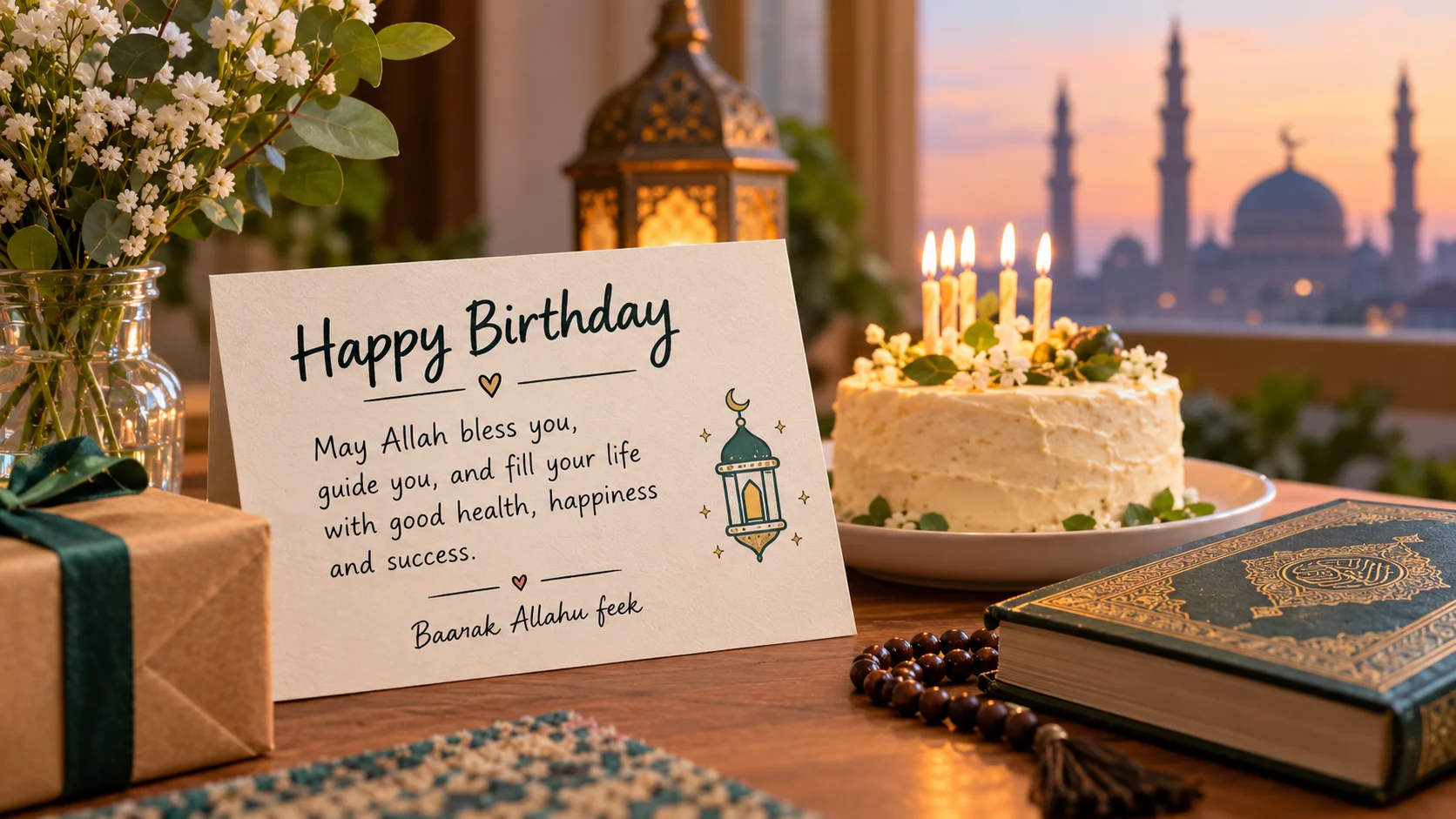
My nephew turned nine last month, and my sister-in-law sent a message in the family group chat that just said “Happy birthday 🎂.” Fine, nothing wrong with it. But my mother-in-law replied underneath with a two-line dua for him — health, guidance, a good heart — and it stuck with me more than the cake emoji did. That’s really the whole idea behind this piece: “happy birthday” gets the job done, but a dua does something more. It asks Allah for the person, instead of just marking the calendar.
If you’ve ever paused before hitting send on a birthday text to a Muslim friend or family member — wondering if “happy birthday” is even the right thing to say, or if there’s something better — this is for you.
Quick answer if you’re in a hurry:
Yes, you can say “happy birthday.” Pair it with a short dua like “Baarak Allahu feek/feeki” (may Allah bless you), and you’re covered for almost any relationship. Scroll to Wishes by Who You’re Sending Them To for ready-to-use lines, or keep reading for the full picture.
Is Celebrating a Birthday Actually Allowed in Islam?
This is the question people are really asking, and it deserves a straight answer instead of a vague “it depends.” So here’s where scholarly opinion actually stands, not just a gesture at “some say this, some say that.”
The position that celebrating birthdays is an impermissible innovation (bid’ah) is held by a number of scholars, particularly within Hanafi and Salafi-leaning circles. Their reasoning: Islam recognizes exactly two sanctioned occasions of celebration — Eid al-Fitr and Eid al-Adha — established by a hadith in which the Prophet ﷺ told the people of Madinah that Allah had replaced their pre-Islamic festival days with these two. Since birthday celebrations weren’t practiced by the Prophet ﷺ or his companions, scholars in this camp treat them as a later addition with no basis in the religion, and some add a concern about imitating non-Muslim custom.
The position that birthdays are permissible as a cultural occasion — not a religious one — is held by others, including Egypt’s Dar al-Ifta (the official fatwa authority), former Egyptian chief mufti Dr. Ali Gomaa, and the widely respected scholar Dr. Yusuf al-Qaradawi. Their reasoning: a birthday, treated as a personal milestone rather than a claimed religious rite, falls under ordinary custom (‘adat), and the default ruling for custom is permissibility unless something forbidden is attached to it (alcohol, mixed-gender parties, extravagance, etc.). Several scholars in this camp go further and suggest turning the day into something spiritually useful — a moment for gratitude, self-reflection, or charity, rather than simply festivity.
What almost nobody disputes, across either position: praying for someone, or telling them “may Allah bless you,” is not the same as staging a celebration. A dua is not a claimed religious rite — it’s Muslims doing what they’d do for each other on any day, just well-timed. That’s the part this article focuses on, and it’s the part that stays safe regardless of which side of the debate you or the person you’re messaging falls on.
Practically, here’s how to apply that:
- If you want to stay clearly on the safer side of the debate, keep your message dua-focused rather than treating the day itself as significant.
- Don’t call it an “Eid.” That term is reserved for Eid al-Fitr and Eid al-Adha specifically — using it for a birthday reads as overreach to people on either side of this issue.
- If you know the person doesn’t celebrate birthdays, a private dua — no cake emoji, no “celebration” language — still lands well. It reads as a prayer for them, not an invitation to something they’ve already said no to.
I’m not a scholar and this isn’t a fatwa — it’s a summary of where public scholarly opinion actually sits, sourced from the positions above. If you or the person you’re messaging follows a specific school of thought with a firmer stance, defer to that.
Matching the Message to the Person — A Quick Guide
Not every birthday message needs the same amount of thought. Use whichever row fits:
| Situation | What to do |
|---|---|
| You don’t know how religious they are | Keep it short and general — “Baarak Allahu feek” + “happy birthday” covers you without assuming anything |
| They’re openly practicing, comfortable with their faith | Go longer, and name something real about their character or their iman — a generic line will undersell the relationship |
| They’ve said they don’t celebrate birthdays | Send something privately, drop celebration language entirely, don’t debate their view |
| You’re texting quickly between things | One sincere line beats a paragraph you didn’t have time to mean |
| You’re writing a card, or something with more weight | Use the longer, personal structure — see When a One-Liner Isn’t Enough |
| They’re going through a hard season or loss | Skip the celebratory tone — “thinking of you today, making dua for you” says more |
| You only know them professionally | A brief “happy birthday” is the safer register — a personal dua may read as more familiarity than the relationship has |
Phrases Worth Knowing
You don’t need to speak Arabic or Urdu fluently to use these — plenty of people drop them into an otherwise English message, and it’s genuinely appreciated even said a little clumsily. None of these are birthday-specific, for what it’s worth — they’re general phrases Muslims use to bless or pray for one another, which is exactly why they fit here.
| Phrase | Script | Rough pronunciation | Meaning | Used for |
|---|---|---|---|---|
| Baarak Allahu feek | بَارَكَ اللهُ فِيكَ | buh-RAH-kah al-LAH-hu FEEK | May Allah bless you | Said to a man |
| Baarak Allahu feeki | بَارَكَ اللهُ فِيكِ | buh-RAH-kah al-LAH-hu FEE-kee | May Allah bless you | Said to a woman |
| Kullu ‘aamin wa anta bikhayr | كُلُّ عَامٍ وَأَنْتَ بِخَيْر | KUL-lu AH-min wa AN-ta bi-KHAYR | May every year find you well | Said to a man (use “wa anti bikhayr” for a woman) |
| Ameen | آمِين | ah-MEEN | So be it | Said after any dua, including someone else’s |
| InshaAllah | إِنْ شَاءَ اللَّه | in-shah-AL-lah | God willing | Tacked onto a hope for the future |
Sincerity carries more weight than a perfect accent — don’t let pronunciation anxiety stop you from using these.
If Urdu fits better for the person you’re messaging:
“جنم دن مبارک ہو! اللہ آپ کو صحت، ایمان اور خوشیوں سے نوازے۔” — Happy birthday, may Allah give you health, faith, and happiness.
“اللہ آپ کی عمر میں برکت دے اور آپ کو ہمیشہ خوش رکھے۔” — May Allah put barakah in your life and keep you happy.
“دعا ہے کہ یہ سال آپ کے لیے دین و دنیا میں کامیابی لے کر آئے۔” — May this year bring you success in both faith and worldly life.
Wishes by Who You’re Sending Them To
Take whichever line is closest to true for your relationship and swap in one real detail — that’s what separates a message someone forwards without reading from one they actually screenshot.
Quick Ones — for a Text or a Comment
- “Baarak Allahu feek — happy birthday! Hoping this year brings you real ease, not just more of the same.”
- “May Allah increase you in health, rizq, and iman this year. Happy birthday, my friend.”
- “Ameen to a lighter year ahead for you. Happy birthday.”
- “May Allah accept your good deeds and forgive your shortcomings this year. Happy birthday.”
- “Happy birthday! May this one treat you better than the last one did.”
For Parents, Siblings, Grandparents
- “You’ve made dua for me my whole life without me ever asking. Today I’m making one for you: many more birthdays, all in good health, surrounded by the people who love you.”
- “Growing up watching you pray for this family taught me what dua even means. Happy birthday, Mom — may Allah reward you for the sacrifices I probably still don’t know about.”
- “From fighting over the TV remote to calling you for advice on everything — happy birthday. May Allah keep you protected and bless your work this year.”
- “You taught me my first surah before I could tie my own shoes. Happy birthday, Dad — may Allah lengthen your life in good health.”
- “You still call to check on me before I remember to call you. May Allah bless you with health that matches your heart, Grandma.”
For a Close Friend
- “You’ve made dua for my exams, my job, and that one situation neither of us talks about anymore. Time I returned the favor — happy birthday, and may Allah answer every dua you’ve made for yourself too.”
- “Here’s to another year of you reminding me to pray on time. Happy birthday — may your iman stay as steady as your nagging.”
- “I don’t know anyone who says astaghfirullah as consistently as you do after losing at Mario Kart. Happy birthday — may Allah bless your patience in the bigger things too.
- “Whoever said friends don’t count as family clearly didn’t have one like you. Happy birthday — may this year be genuinely easier than the last.
For a Spouse
- “You’ve prayed beside me through job losses, house moves, and pointless 3 a.m. arguments. Happy birthday — may Allah reward you for making sabr look easier than it is.”
- “May Allah keep us partners in this life and, inshaAllah, the next one too. Happy birthday, habibi.”
- “Every year with you makes me a little more convinced dua actually works. Happy birthday — may He bless whatever’s ahead as much as He’s blessed what’s behind us.
For a Child
- “May Allah make you a hafiz of Qur’an one day, and keep you smiling exactly like this. Happy birthday!”
- “You already know more du’as than half the adults in this family. Happy birthday — may Allah keep that heart of yours this soft forever.”
- “Another year of you asking ‘why’ about everything — never stop. May Allah guide that curiosity toward good. Happy birthday!”
When a One-Liner Isn’t Enough
This is closer to what works in a card, or for someone going through something real:
“Happy birthday. I was thinking today about how much has changed for you since your last one — the good and the hard parts both — and honestly, I’m proud of how you’ve handled it. My dua for you this year is simple: that Allah makes what’s difficult easy, gives you clarity where you’ve been confused, and surrounds you with people who bring out the best in your deen and your character. May He bless your health, your work, and the relationships that matter most to you. Ameen.”
How to write your own from scratch, if none of the above quite fits:
- Start with something true and specific about the person — a memory or habit, not “you’re amazing.” This is what makes it sound written for them.
- Say what you’re actually asking Allah for on their behalf — one or two things true for their life right now (ease, health, patience with something specific), not a generic list.
- Close with a dua word — “Ameen,” “InshaAllah,” or “Baarak Allahu feek/feeki” — so it ends on a note of asking rather than just stating.
What to Say About Your Own Birthday
This gets skipped a lot, but people search for it constantly — what do you post or say about your own birthday without it turning into a celebration you weren’t going for?
Quietly, to yourself: “Ya Allah, thank You for another year of life. Forgive what I fell short on, accept what I did for You, and make the year ahead better than the one behind me.”
Publicly, if you’re posting: “Not a celebration, just gratitude — Alhamdulillah for this year of life.” Or simply “Another year closer to the akhirah. Alhamdulillah for all of it.”
The tone that tends to land well is gratitude, not achievement — “thank You for getting me here” rather than “look how far I’ve come.”
A Few Things to Avoid
- Calling it an “Eid.” That word is reserved for the two actual Eids — using it for a birthday, even casually, reads wrong to people on both sides of the celebration debate.
- Sending the exact message you sent someone else last week. If it doesn’t mention anything true about the person you’re actually messaging, it reads like it was written for no one in particular — because it was.
- Assuming everyone marks birthdays the same way. Some people genuinely don’t, for religious reasons. A quiet private dua respects that better than a public “happy birthday” would.
- Skipping the dua because “HBD 🎂” is faster. It’s not wrong, but a one-line dua takes about ten seconds longer and means considerably more.
Questions People Usually Have
Is celebrating birthdays haram in Islam?
It’s genuinely disputed. Hanafi and Salafi-leaning scholars generally treat it as bid’ah (innovation) since it has no basis in the Prophet’s ﷺ practice; Egypt’s Dar al-Ifta, Dr. Ali Gomaa, and Dr. Yusuf al-Qaradawi, among others, treat it as permissible custom as long as nothing forbidden is involved. Both sides agree wishing someone well or making dua for them isn’t the part in question.
Can I say “happy birthday” to a Muslim friend?
Yes. Pairing it with a short dua covers you regardless of where the person stands on the celebration debate.
Did the Prophet ﷺ say a specific dua for birthdays?
No — there’s no authentic dua tied specifically to birthdays, since the occasion wasn’t marked as a tradition during his lifetime. People draw on general duas for blessing, health, and a good life instead.
What’s a good short dua for someone’s birthday?
Baarak Allahu feek” (to a man) or “Baarak Allahu feeki” (to a woman) — both mean “may Allah bless you” — paired with one specific line about what you’re actually asking Allah for on their behalf.
What should I write in a card?
One true detail about the person, one specific dua for their health or their deen, and a closing word like “Ameen” or “InshaAllah.”
How do I say “happy birthday” in Arabic, the Islamic way?
There’s no single fixed religious phrase, since birthdays aren’t a religious occasion — but “Baarak Allahu feek/feeki” is what’s most commonly used, usually alongside a specific dua.
Is there a hadith about birthdays specifically?
Not directly. The hadith scholars do cite is the one about the two Eids replacing pre-Islamic festival days — used by some to argue birthdays fall outside sanctioned celebration. There’s no hadith that addresses personal birthdays by name.
What should I say to someone I consider a sister or brother in faith but who isn’t family?
Something like “Baarak Allahu feek/feeki — may this new year bring you closer to Allah and lighter on everything else.” Warm, without overreaching if you don’t know them that well.
What should I post about my own birthday?
Gratitude reads better than celebration — “Alhamdulillah for another year of life,” paired with a quiet dua for forgiveness for the year behind and ease for the one ahead.
DISCOVER MORE ARTICLES
Anniversary Wishes for Uncle & Aunty That Feel Real
85 Classy Woman Quotes That Feel Truly Personal
Good Afternoon Texts for Her (That Get a Reply)

Shahzad is the Founder of BlessCentral, sharing heartfelt blessings, prayers, wishes, Bible verses, and inspirational messages to bring faith and encouragement into everyday life.




Leave a Reply